
Episode 5- Islamabad chapter 1992 – Entering into a blue door
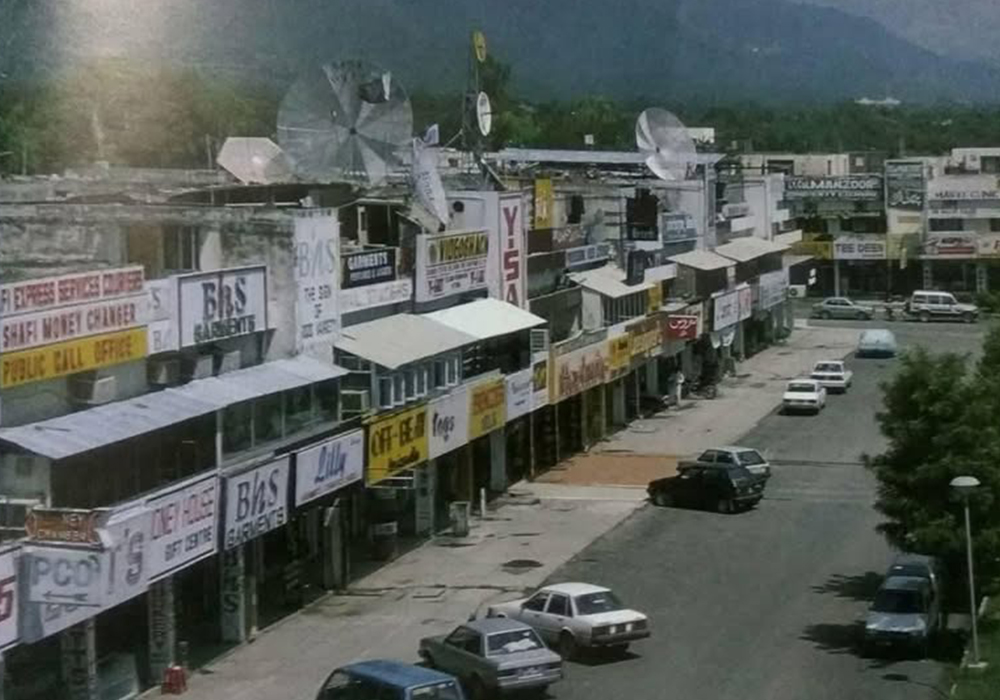
While talking about my side hustles alongside the Yellow Pages job, I felt like talking about the city, the culture, and the overall feel of the place I was roaming around in.
My mornings were spent at ICMA H-9 campus (where, mostly, I was sleeping in class), and my days were spent roaming around the Blue Area. Compared to today, the city was much smaller then. My evenings were often spent at a cabin (khokha) right under the umbrella of Lal Masjid, on the green belt, which felt more like a small forest. The tuitions I had started getting were mostly in the surroundings of G-6/4 sector. Later, after all this, I would go to Rawalpindi’s Asghar Mall to meet school friends, often staying out very late at night and returning home completely exhausted.
Studying, job, tuitions, and wandering made my days full of activity and nonstop socialisation.
Both cities were calm, peaceful, and quite liberal and fashionable, much like today—except there was no internet or mobile phones. Another difference was that in Jinnah Super (the most modern place at that time), you would see many Europeans enjoying the same liberties they could openly express on the streets of London and Paris.
Gate-crashing music concerts and sneaking into dance parties was another adventure for youth like me.
When I reflect on those times, I feel that although there was a very clear status quo among sectors—since homes were allocated according to the grades of government officials, such as G-6/2, G-6/4, and G-6/3—there was far less show-off. There was not much segregation based on financial status, or perhaps such distinctions were not very noticeable to young, eager minds. I am not sure about today’s situation of youth in society in terms of socio-economic segregation, but I feel materialism has a much stronger impact now.
For me at that time, living in Rawalpindi and sneaking into a dance party in F-8 after hiding your motorbike in an adjacent jungle was more fun and adventure than frustration.
These and many similar topics open up a broader discussion about past and present—about liberalism, culture, and the endless debate over what was good or bad then and now. That discussion would certainly divert me from my original work biography notes. Still, I felt that adding some detail about my surroundings and the aroma of the city would help me craft memories of work in a more eloquent manner.
It is like talking about the winds, air pressure, and clouds of the skies where you first learned to fly.
The second tuition I got was in G-6/3. I don’t remember much about the students or children, except that it was a corner house parallel to the single road of Blue Area, at the edge of G-6/3. I do remember a very kind lady of the house who served me tea and biscuits every day. This household was quite the opposite of the doctor’s house, and no one was observing me from behind thick veils.
At ICMA, there was all the boring commerce I never liked. At Yellow Pages, there were daily sales, and I was feeling more confident. Tuitions were often tiring, and I frequently felt sleepy—unless the household was kind enough to give me strong tea, followed by more tea later at the jungle khokha. My day would start at 8 a.m. and usually end around 2 a.m.
This was life. This was almost my fourth month at Yellow Pages. And while knocking door to door, I once knocked on a blue door on the first floor of a corner building in Blue Area, China Chowk—and a new chapter of my life began with that opened door.